
News
Minelab Gold Monster 2000 Echo Audio Guide: 528 Hz Threshold & Target Tones Explained
Oct
Decoding the Echo Audio on the Minelab Gold Monster 2000: The Acoustic Science of Finding Gold
When swinging a detector across mineralised ground for eight hours straight, your ears are just as critical as your coil. In gold prospecting, faint signals are everything—a whisper of a response or a slight wobble in pitch is often the only difference between walking past a sub-gram nugget and putting gold in your bottle.
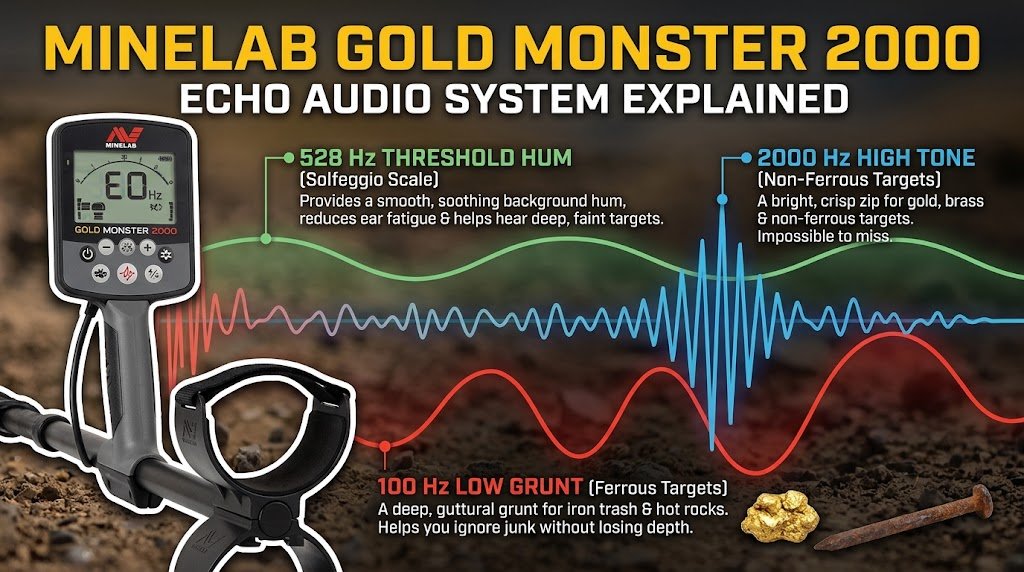
With the release of the Minelab Gold Monster 2000, Minelab introduced Echo Audio (part of their Echo Wave™ acoustic profiling). Rather than relying on simple, harsh beeps or completely silent discrimination that masks deep targets, Echo Audio blends continuous acoustic feedback with sharp, dual-tone target profiling.
Here is an in-depth breakdown of how the three core audio pillars—the 528 Hz threshold tone, the 2,000 Hz non-ferrous zip, and the 100 Hz iron grunt—work together to make prospecting faster, less fatiguing, and far more productive.
1. The 528 Hz Threshold Hum: Acoustic Ergonomics & the “Miracle Tone”
In metal detecting, the threshold is the steady, gentle background tone that hums while you swing. It isn’t there just for ambience; your brain uses sudden drops, breaks, or subtle pitch ripples in that hum to recognise targets buried at the fringe of detection depth.
In the Gold Monster 2000, setting this baseline threshold to 528 Hz bridges acoustic science with harmonic frequency theory:
The Solfeggio Scale Connection: The “Mi” Frequency
On the ancient and alternative Solfeggio scale, 528 Hz is celebrated as the “Transformation & Miracles” (or “Love”) frequency (traditionally tied to the syllable Mi from the hymn Ut Queant Laxis). Proponents of alternative acoustics and sound healing attribute remarkable qualities to 528 Hz—claiming it promotes mental clarity, cellular harmony, stress reduction, and deep grounding. While sound therapy claims remain in the realm of holistic wellness, bringing that frequency to the goldfields introduces very real acoustic advantages.
Why 528 Hz Works in a Gold Detector:
- Combatting “Detectorist Ear Fatigue”: Traditional detector threshold hums often sit at harsh, high pitches or droning low buzzes that leave operators with ringing ears and headaches after several hours under tight headphones. At 528 Hz (roughly equivalent to a C5 note), the pitch is smooth, clean, and warm. It is easy on the human auditory canal, allowing prospectors to listen intently for an entire day without mental exhaustion.
- Peak Human Hearing Dynamic Range: The human ear is exceptionally sensitive to mid-range frequencies between 500 Hz and 3,000 Hz. Placing the continuous hum right at 528 Hz puts it directly into a sensory “sweet spot”—loud enough to perceive micro-variations when the coil glides over a deep speck, yet subtle enough not to overpower true target hits.
- A Calming Focus: Gold prospecting is a mental game requiring patience and unwavering focus. The harmonic richness of 528 Hz creates a steady, rhythmic baseline that keeps you dialled in and alert to the slightest change in ground feedback.
2. The 2,000 Hz High Tone: Crisp Precision for Non-Ferrous Targets
When your coil sweeps over native gold, brass, lead, or copper, the Echo Audio system cuts through the background hum with a razor-sharp 2,000 Hz tone.
The Psychology and Physics of 2,000 Hz:
- Instantaneous Contrast: Going from a 528 Hz threshold to a bright 2,000 Hz hit creates a steep, impossible-to-miss acoustic contrast. Even on a rapid swing, your auditory cortex registers the spike instantly, prompting you to immediately stop and investigate the spot.
- Sensitivity to Ultra-Fine Specks: Small gold nuggets—especially the sub-grain “fly-poop” pieces that the Gold Monster’s high-frequency multi-frequency engine excels at finding—exhibit brief, rapid signal responses. A high-frequency pitch at 2,000 Hz has shorter sound wave periods, making fast, transient signals sound punchy, bright, and defined rather than muddy.
- Separation in Clutter: In trashy ground or areas littered with mineralised hot rocks, a 2,000 Hz signal pierces cleanly through residual low-end chatter, giving you the confidence that something conductive and non-ferrous is sitting under the coil.
3. The 100 Hz Low Grunt: Taming Iron Trash & Hot Rocks
Digging every iron boot tack, rusty tin shard, wire scrap, and hot rock on an old goldfield is the fastest way to burn out. To keep your shovel reserved for targets that count, Echo Audio assigns a gut-level 100 Hz low grunt to ferrous trash.
Why 100 Hz is Essential:
- Gut-Level Discrimination: Sitting near the bottom of audible bass (near G2), a 100 Hz tone sounds like a heavy, guttural rasp. It triggers an intuitive, immediate reaction: iron / skip it. You don’t even have to look at the screen or the Gold Chance Indicator meter.
- No Blanking or Depth Loss: In traditional silent-search or aggressively notched discriminators, iron signals are completely muted, which can cause the detector to “blank” or go temporarily deaf over dense trash—masking a gold nugget sitting right next to an iron nail. Echo Audio’s 100 Hz grunt keeps audio active; you clearly hear the ferrous object register and pass, allowing the threshold to instantly recover without dead air.
- Telling Hot Rocks Apart: Highly magnetic mineral hot rocks often mimic targets on standard VLF detectors. The low grunt cleanly flags their ferrous profile, saving your knees and back from digging phantom targets in tough ground.
The Verdict: A Symphony for the Goldfields
By structuring Echo Audio around 528 Hz, 2,000 Hz, and 100 Hz, the Minelab Gold Monster 2000 turns target audio into an intuitive language:
| Audio Component | Frequency | Role | Field Advantage |
| Threshold | 528 Hz (Solfeggio “Mi”) | Baseline background hum | Reduces ear fatigue; harmonic focus; highlights deep edge targets |
| Non-Ferrous | 2,000 Hz | Positive target response | Sharp, piercing alert for fine gold & high conductors |
| Ferrous | 100 Hz | Reject/Trash grunt | Intuitive iron identification without masking or depth loss |
Instead of fighting ground noise or second-guessing scratchy signals, your ears do the heavy lifting—keeping your focus sharp, your swings steady, and your gold pouch full.
As always, happy prospecting and stay Safe
Subscribe to the THP Newsletter
