
News
The Invisible Conversation Happening Beneath Your Detector Coil [how does a gold detector work]
Jun
The Secret Language of the Earth: Why Gold Detection Is More Physics Than Luck
Gold prospecting is often romanticized as a hunt for buried treasure, but in reality, it is a high-stakes “conversation” with the ground beneath your feet. To find gold, you aren’t just listening for a lucky beep; you are operating a high-tech metal sniffer that communicates through the invisible medium of magnetism. The physics of this hunt is often more surprising than the find itself, as every signal is governed by the rigid, uncompromising laws of electricity and time.
1. Your Detector is Having a Two-Way Conversation
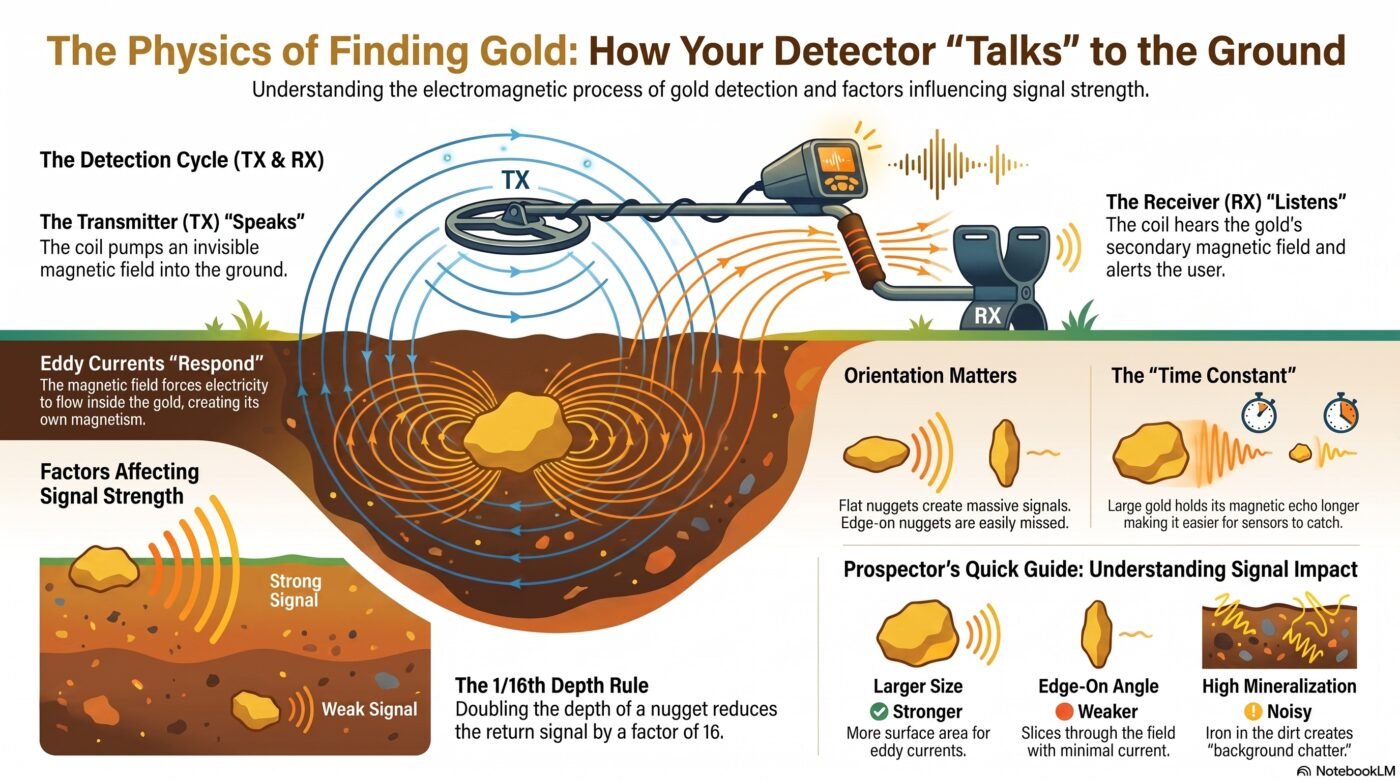
A metal detector does not simply “see” gold; it talks to the ground and listens for a response. This process happens within the coil at the bottom of the device, which houses two separate antennas working in tandem:
- The Transmitter (TX): Functioning like a speaker, the TX pumps an invisible magnetic field down into the dirt.
- The Receiver (RX): Functioning like an ear, the RX listens for any magnetic changes happening in the soil.
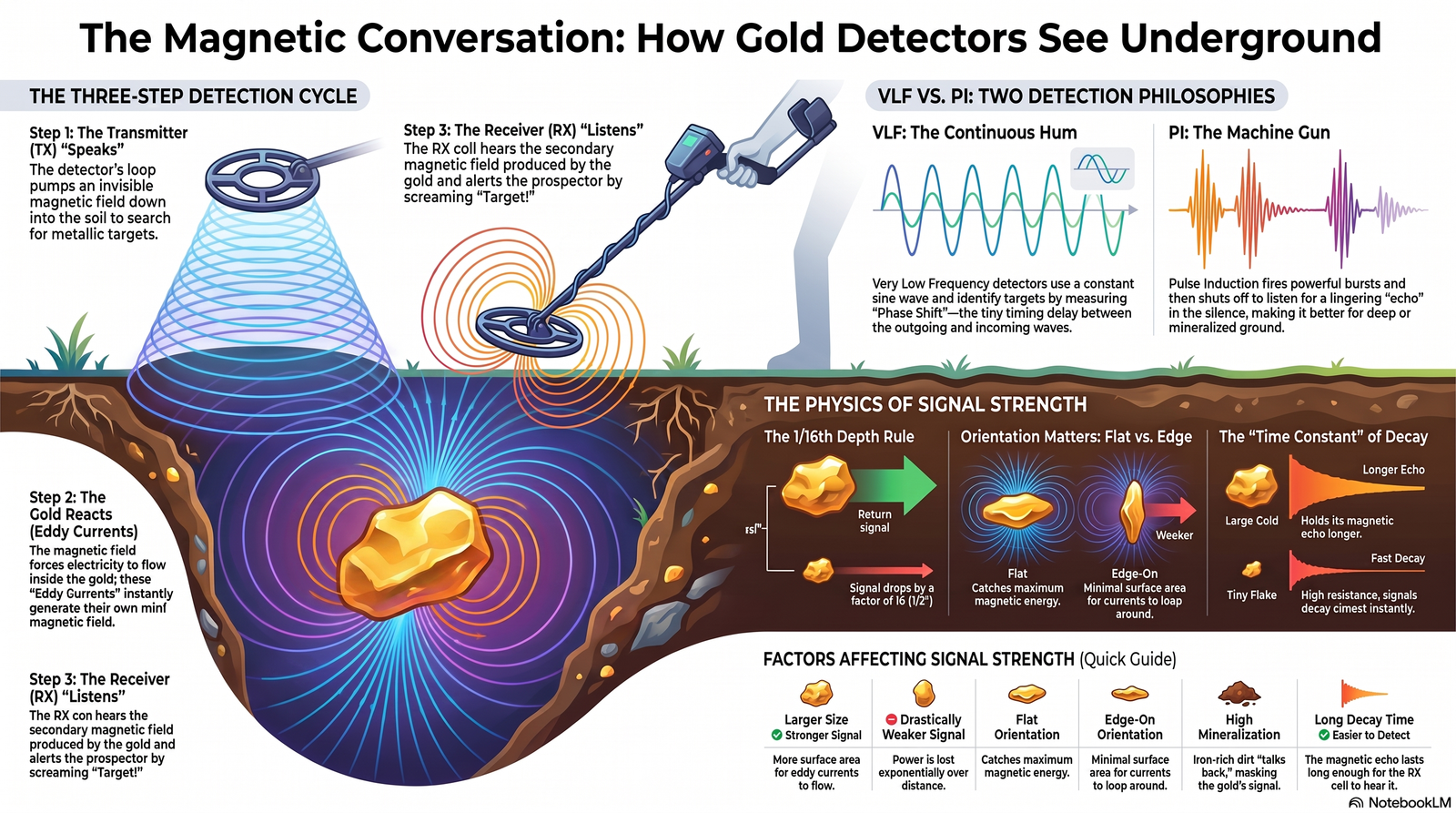
When the transmitter’s magnetic field passes over a piece of metal, it forces electricity to flow inside the object, creating Eddy Currents. Because electricity and magnetism are “twins,” these internal currents instantly generate their own secondary magnetic field.
“It’s essentially a two-part conversation: the detector talks to the ground, and if there is gold down there, the gold talks back.”
It is a profound realization for any prospector: the detector never actually “detects” the gold itself. It only detects the electricity moving within the metal. Understanding this internal current is the key to moving beyond just listening for beeps; you are essentially monitoring a physical reaction to the energy you’ve pumped into the earth.
New Arrival
Limited Stock
Goldmonster GM10 Super Tuff Skid Plates.

2. The “Machine Gun” vs. The “Continuous Hum” (vlf vs pulse induction)
There are two primary ways detectors manage this conversation, and the engineering “secret sauce” lies in the microscopic precision of the timing between signals.
Very Low Frequency (VLF): The Continuous Hum VLF detectors operate like a continuous, unbroken hum. The TX coil transmits a smooth, constant sine wave while the RX coil listens simultaneously. To distinguish between a rusted nail and a gold nugget, VLF machines use a trick called Phase Shift, which measures the tiny delay in timing between the outgoing wave and the returning signal.
Pulse Induction (PI): The Machine Gun PI detectors operate like a machine gun, firing powerful bursts of magnetism into the ground and then shutting off completely. While the transmitter is silent, the RX coil listens for an “echo in the dark.” When the magnetic pulse stops, the magnetism in the ground crashes to zero, but a piece of gold will hold onto its eddy currents for a fraction of a millisecond.
The real engineering feat here isn’t just power—it’s the “silence.” The detector must be fast enough to shut off its “shouting” and open its “ears” in the microscopic window before the gold’s signal vanishes.
3. The Brutal Geometry of Depth (The 1/16th Rule)
One of the most sobering realities of prospecting is how aggressively magnetic fields fade over distance. In physics, this is known as the Inverse Fourth Power Law, and it is the primary reason why “deep gold” is so hard to find.
Signal strength follows a punishing decay curve. Because the magnetic field must travel from the coil to the target (fading at a rate of 1/d^2) and the return signal must travel from the target back to the coil (fading at another 1/d^2), the resulting signal strength is the product of the two: 1/d^4.
In practical terms, this means if you double the depth of a nugget, the signal returning to your detector doesn’t just cut in half—it drops by a factor of 16 (1/2^4). This aggressive physics explains why even a massive nugget can remain “hidden” just two or three inches deeper than the detector’s reach; the signal simply vanishes into the background noise of the universe.
4. Why a Gold Nugget Can “Hide” in Plain Sight
A nugget’s detectability is determined as much by its Orientation as its size. Because gold nuggets are rarely perfect spheres, their position relative to the coil changes how much energy they can “catch.”
- Flat/Face-Up: A nugget lying horizontally acts like a solar panel. It presents a massive surface area to the TX field, catching maximum energy and creating large eddy currents for a booming signal.
- On-Edge: If the same nugget is standing vertically, the TX field “slices” right past it. With very little surface area to catch the magnetism, the eddy currents are minimal, resulting in a weak, missable signal.
This creates a frustrating reality: you could walk right over a fortune simply because of how it’s sitting in the dirt. This is why professional prospectors never trust a single pass; they swing the coil from multiple angles to ensure they aren’t “slicing” past a vertical prize.
5. The Invisible Enemy: Mineralization and Noise
The earth is not inert; it is often packed with “Iron Dirt” containing minerals like maghemite and hematite. This mineralization acts like a massive, continuous sheet of metal that “talks back” to the detector constantly, drowning out the discrete, tiny signal of a gold nugget.
In VLF detectors, this ground noise can be deafening. PI detectors are the superior choice for mineralized ground because they utilize a “timing gap.” While iron minerals lose their magnetic response the instant a pulse stops, gold holds onto its magnetism just a fraction longer. By waiting for the iron’s response to die before “opening their ears,” PI detectors can effectively see through the red dust to the gold beneath.
6. The Race Against the “Decay Time”
When a detector’s pulse shuts off, the signal from the target begins to fade, or decay. The speed of this decay—known as the Time Constant—is the ultimate barrier to finding small gold.
- Large Gold: Big nuggets have low electrical resistance. Resistance acts as a “brake” on electrical flow; because it is low in large nuggets, eddy currents loop easily and take a long time to fade. This “long echo” is easy to catch.
- Small/Specimen Gold: Tiny flakes or “spongy” specimens have high electrical resistance. Their signals flash and vanish almost instantly.
For the smallest flakes, the “echo” often happens and disappears while the detector is still “shouting” its pulse. If the signal decays before the RX coil can turn on, the gold is physically impossible to hear.
Physics at a Glance: Why Signals Vary
| Factor | Effect on Signal | The Physics Why |
| Larger Size | 🟢 Stronger | More surface area for eddy currents to flow. |
| Greater Depth | 🔴 Drastically Weaker | The Inverse Fourth Power Law (1/d^4) kills the signal. |
| Flat Orientation | 🟢 Stronger | Acts like a solar panel catching maximum energy. |
| Edge-On Orientation | 🔴 Weaker | Slices through the field, generating minimal current. |
| High Mineralization | 🟡 High Noise | The dirt provides a continuous signal that masks the gold. |
| Long Decay Time | 🟢 Easier to Detect | Large gold overcomes resistance to keep the “echo” alive. |
Conclusion: Beyond the Beep
Successful gold prospecting is far more than a walk in the woods; it is the active management of magnetism, geometry, and millisecond-fast timing. To find gold, you must account for the way a nugget sits in the earth, the mineral “noise” of the soil, and the relentless decay of electrical currents.
The next time you hear a detector beep, ask yourself: are you just hearing a lucky sound, or are you witnessing a perfectly timed physical echo from a conversation hidden beneath the earth? Will you ever look at the “simple” ground beneath your feet the same way again?
Stay Safe

Subscribe to the THP Newsletter
